
Maintenance Guide: Keeping Your ThermoWood® Looking Beautiful
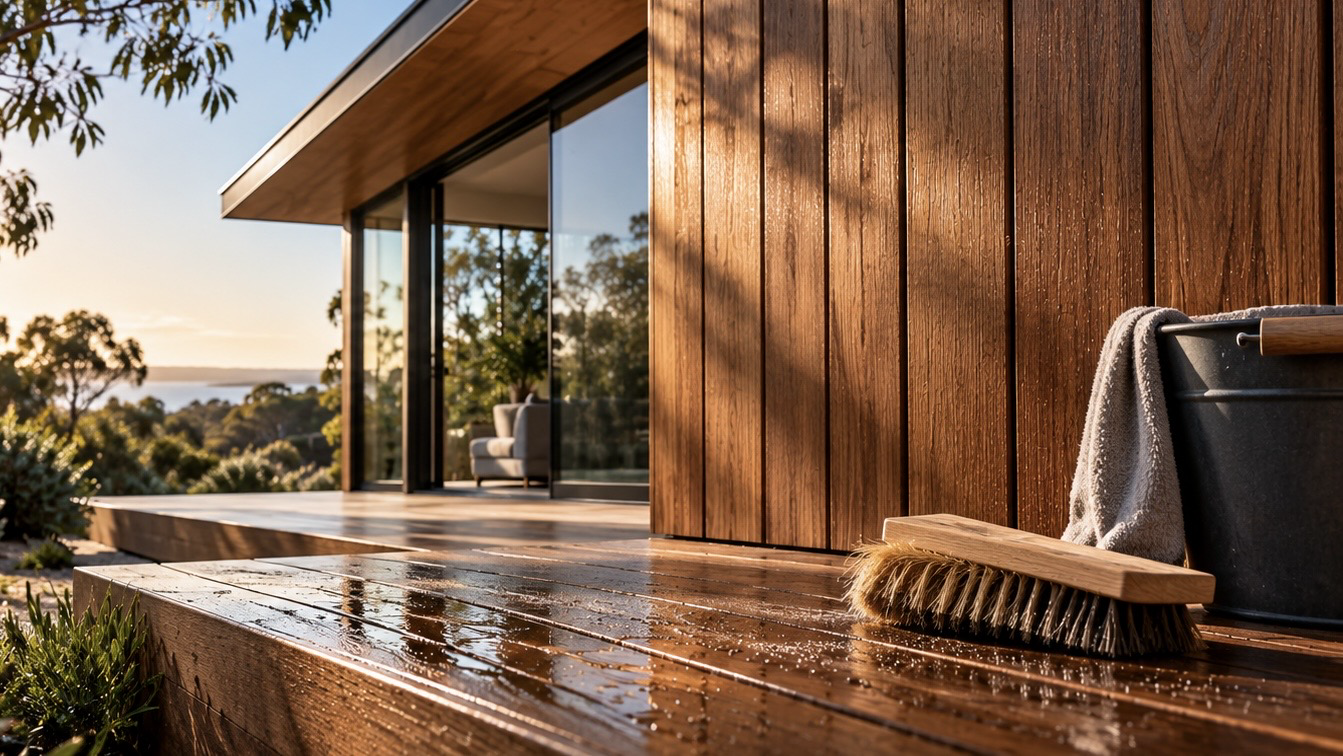
A comprehensive guide to cleaning, oiling, and maintaining thermally modified timber for long-lasting architectural beauty.
Contents
Natural timber brings warmth, texture and authenticity to architecture. From vertical timber cladding on a contemporary Sydney home to a sheltered outdoor ceiling or a carefully detailed deck, its appeal lies in a surface that is genuinely alive to light and the seasons.
Thermally modified timber—often called ThermoWood®—adds a valuable advantage: heat treatment reduces moisture uptake and improves dimensional stability compared with the same untreated species. But one question remains: how do you keep that rich timber appearance looking its best?
The answer is straightforward: decide whether you want to preserve the original brown tone or embrace natural silver-grey weathering, then choose a simple maintenance plan suited to the location and finish. At AXIS™ Timber Surfaces, we work with architectural timber manufactured by Tantimber® and help Australian designers, builders and homeowners make informed material choices.
1.Does ThermoWood® Need Maintenance?
During thermal modification, controlled heat changes wood chemistry, generally reducing its equilibrium moisture content and swelling or shrinkage. That does not make the surface immune to sunlight, dirt, standing water, mould or physical wear.
Tantimber® explains that maintenance of its ThermoWood® products is primarily a visual choice: outdoor colour fading does not itself mean the thermal modification has stopped working. However, regular inspection, cleaning, sound drainage and appropriate installation remain important to the performance of any timber assembly.
A helpful distinction:
- Durability: the ability of the correctly specified timber and building assembly to withstand its intended environment.
- Appearance: whether the surface remains brown, becomes silver-grey, or develops local staining.
- Maintenance: cleaning, inspection, and—if the chosen aesthetic requires it—renewal of a compatible finish.
A weathered grey façade is not automatically a failed façade. Conversely, a freshly oiled surface is not proof that moisture, fixings and ventilation have been properly managed.
2.Why Does Thermally Modified Timber Change Colour?
The deep brown tones of thermally modified ash, pine or ayous come from changes in the wood during heat treatment. Outside, ultraviolet (UV) radiation gradually affects the surface. Rain, shade, airborne particles and local moisture conditions influence how that surface ages.
Without a UV-protective finish, exposed timber typically shifts towards silver-grey. The change is often uneven at first: a sun-exposed western wall may weather faster than a sheltered soffit or a shaded façade beneath a generous roof overhang.
This is natural weathering—not evidence that the timber was poorly treated. A suitable pigmented coating can slow the change where colour retention matters.
Two legitimate architectural finishes
Keep the warm brown colour
Specify a compatible, exterior-grade pigmented finish with UV protection and plan to renew it as the manufacturer directs.
Let the timber silver naturally
Leave a suitable product uncoated where the manufacturer permits it, accepting gradual and potentially uneven weathering. Continue inspecting and cleaning the surface and the building details.
3.How to Clean ThermoWood® Safely
For routine dirt, pollen and dust, a gentle method is usually the best starting point.
A practical cleaning sequence
Inspect the boards, joints, fixings and drainage paths. Identify loose components or areas holding water before washing.
Brush away leaves, cobwebs and loose debris with a soft brush.
Wash with clean water and, where needed, a mild cleaner specifically approved for the installed finish or timber product. Test a small inconspicuous area first.
Use a soft-bristle brush along the grain. Avoid aggressive scrubbing that raises or damages the wood fibres.
Rinse gently and allow the timber to dry thoroughly. Follow the finish manufacturer’s instructions before applying any new coating.
What should you avoid?
- High-pressure washing at close range, which can damage wood fibres, coatings and joints.
- Harsh bleach, strong acids, unapproved solvents or abrasive wire brushes.
- Leaving wet leaves, planters or debris against timber surfaces.
- Applying oil or coating to dirty, wet or contaminated boards.
- Mixing cleaning or coating products without checking compatibility.
4.Should You Oil ThermoWood®?
If the goal is to preserve the original brown appearance, Tantimber® recommends water- or solvent-based wood protectants containing pigment. Pigments help protect against UV-driven greying; clear finishes typically offer less UV protection.
Choose a product explicitly suitable for the relevant thermally modified species, profile, exposure and intended use. Decking finishes may differ from vertical cladding finishes, and an interior oil should not be assumed suitable for exterior weather.
Before applying a finish
- Confirm the manufacturer’s approved coating system and any warranty conditions.
- Check whether the timber is supplied unfinished, prefinished or factory-coated.
- Clean and dry the boards to the coating manufacturer’s required conditions.
- Follow instructions for surface preparation, end grain, number of coats, coverage and drying times.
- Apply a test patch to assess final colour and sheen.
Avoid applying excess oil: puddling or incomplete absorption can produce uneven appearance or tacky areas. Do not assume that ordinary household oils are suitable exterior wood finishes.
How often should you re-oil?
There is no universal six-month, annual or two-year rule for all ThermoWood®. Recoating depends on the coating chemistry, UV exposure, orientation, rainfall, traffic and desired appearance. Inspect annually as a practical starting point, and follow the specific coating manufacturer’s published maintenance interval and visible signs of wear. Decking and exposed west-facing elevations may need more attention than sheltered cladding.
5.ThermoWood® Cladding, Decking and Interiors: Different Care Needs
Exterior cladding
Typical concern
UV greying, dirt, water at joints
Recommended approach
Inspect annually; gently clean; renew compatible pigmented finish when required
Decking
Typical concern
Foot traffic, trapped debris, surface wear and slip risk
Recommended approach
Clean more frequently as needed; check drainage, fixings and coating wear
Screens and battens
Typical concern
Uneven sun exposure and hard-to-reach faces
Recommended approach
Plan access; inspect connections and weathered edges
Sheltered soffits
Typical concern
Uneven colour compared with exposed façades
Recommended approach
Dust or clean gently; assess whether colour matching is necessary
Interior wall or ceiling linings
Typical concern
Dust, fingerprints, accidental scuffs
Recommended approach
Soft dusting; use only finish-compatible cleaners; avoid unnecessary soaking
| Application | Typical concern | Recommended approach |
|---|---|---|
| Exterior cladding | UV greying, dirt, water at joints | Inspect annually; gently clean; renew compatible pigmented finish when required |
| Decking | Foot traffic, trapped debris, surface wear and slip risk | Clean more frequently as needed; check drainage, fixings and coating wear |
| Screens and battens | Uneven sun exposure and hard-to-reach faces | Plan access; inspect connections and weathered edges |
| Sheltered soffits | Uneven colour compared with exposed façades | Dust or clean gently; assess whether colour matching is necessary |
| Interior wall or ceiling linings | Dust, fingerprints, accidental scuffs | Soft dusting; use only finish-compatible cleaners; avoid unnecessary soaking |
6.Design Details That Reduce Future Maintenance
The most effective maintenance strategy often begins on the drawing board.
Keep water moving
Provide drainage and appropriate ventilation behind cladding. Avoid details that trap moisture against board ends, horizontal ledges or concealed cavities. Follow the approved installation system for flashings, clearances and joints.
Protect exposed end grain
Cut ends can absorb moisture more readily than board faces. Where required by the product or coating system, protect end grain using the specified treatment and follow installation instructions.
Specify appropriate fixings
Use the corrosion-resistant fixings recommended for the particular thermally modified timber and exposure. The ThermoWood® Handbook(opens in a new tab) discusses the potential effect of thermally modified timber’s acidity on metal fasteners.
Design for inspection
Consider how someone will safely reach upper-storey cladding, replace a damaged board or clean an exposed screen. A beautiful façade should also be maintainable.
7.Australian Conditions: Coastal Air, Strong UV and Variable Exposure
Australia’s climates are diverse, so maintenance should respond to the actual site rather than a generic schedule.
Coastal homes
Salt deposits, wind-driven rain and corrosion risk make cleaning, fixings and drainage especially important. Check the suitability of the full cladding system for the location.
Sun-exposed façades
Intense UV can accelerate visible colour change. If retaining brown tones is a priority, specify a compatible pigmented finish and anticipate ongoing renewal.
Shaded or humid locations
Persistent dampness, organic debris and limited airflow can encourage surface mould or algae. Keep surfaces clean and address water-trapping details.
Covered outdoor areas
Sheltered timber often weathers more slowly than adjacent exposed elements, creating a natural contrast. Plan for this when choosing a consistent façade aesthetic.
There is no single maintenance calendar that fits every Australian project. Orientation, local weather, detailing and finish matter more than a fixed promise of years between recoats.
8.Real-World Industry Guidance: What the Experts Say
Industry guidance
Tantimber®: Weathering is not the same as loss of durability
In its published FAQ, Tantimber® distinguishes visual maintenance from the durability benefits of thermal modification. It explains that uncoated timber can turn grey and recommends pigmented wood protectants where colour retention is desired. This supports an important specification decision: choose a finish based on the aesthetic outcome, not on the mistaken belief that every ThermoWood® surface must be regularly oiled to remain durable.
Industry guidance
AXIS™ guidance: Exposure and detailing drive performance
Sunlight changes uncoated timber towards silver-grey, and maintenance frequency depends on the finish and weather exposure. Established exterior timber practice stresses drainage, ventilation, inspection access and planned maintenance. The practical lesson is that long-term performance depends on both material selection and architectural detailing.
Industry guidance
Timber Decking and Cladding Association: Coating quality matters
The UK’s Timber Decking and Cladding Association recommends factory-applied coating where appropriate for consistent coverage, and careful protection of coatings during transport and installation. For projects where uniform colour is central to the design, early discussion of factory finishing can reduce avoidable variation and site labour.
Source: TDCA — Coated Exterior Timber Cladding(opens in a new tab)
These are published industry guidance examples—not claims that a particular AXIS project has achieved a measured service life or that a coating will last a guaranteed number of years.
9.A Simple ThermoWood® Maintenance Checklist
At handover
- Record the timber species, profile, finish brand and colour, and installation date.
- Obtain product-specific care and coating instructions.
- Photograph the original appearance and key joints.
During routine care
- Remove dirt, leaves and organic debris.
- Inspect for water accumulation, coating wear, loose fixings and damaged boards.
- Clean gently using approved products.
When colour retention matters
- Assess UV fading and water repellency.
- Recoat only when needed and according to the specified finish system.
- Record the maintenance date and products used.
If you notice a problem
- Investigate repeated wetting, mould, unusual distortion or deteriorated fixings.
- Seek advice from the installer, manufacturer or suitably qualified building professional where appropriate.
10.Discover Architectural ThermoWood® With AXIS™
Thermally modified timber gives architects and designers the freedom to work with authentic wood grain, rich natural tones and refined profiles. A well-considered maintenance strategy helps protect that design intent long after installation.
At AXIS™ Timber Surfaces, we connect Australian architects, interior designers, builders and homeowners with selected thermally modified timber products manufactured by Tantimber®.
Frequently Asked Questions
Does ThermoWood® need oiling every year?
No. There is no universal annual oiling requirement. Oiling may be used to preserve a particular colour, and frequency depends on the finish, location and exposure. Follow the manufacturer-approved coating system.
Will thermally modified timber turn grey outdoors?
Yes, uncoated exterior timber generally weathers towards silver-grey under UV exposure. The rate and uniformity vary with sun, rain, shade and orientation.
Can I leave ThermoWood® untreated?
Some appropriately specified thermally modified timber products can be left uncoated to weather naturally, where the manufacturer permits it. This does not remove the need for inspection, cleaning, good drainage and correct installation.
What is the best oil for ThermoWood®?
Use a coating approved for the specific timber and application. For retaining brown colour outdoors, Tantimber® recommends a pigmented wood protectant. Confirm compatibility, preparation and recoating instructions before use.
Can I pressure-wash ThermoWood® decking?
Avoid aggressive high-pressure washing, which can damage fibres and coatings. Use gentle cleaning methods and follow the product manufacturer’s guidance.
How do I maintain ThermoWood® cladding in Sydney?
Inspect periodically, clear debris, gently clean when needed and check moisture-prone details. For colour retention, follow the approved pigmented coating’s maintenance instructions. Coastal exposure, shade and sun orientation will influence the schedule.
Does greying mean ThermoWood® is rotting?
No. Silver-grey weathering is commonly a surface colour change caused by exposure. Persistent dampness, softness, fungal growth or structural damage warrants closer investigation.
Conclusion: Let the Material Age Beautifully
The best ThermoWood® maintenance plan begins with a design choice: preserve its original warm brown tone, or celebrate the natural silver-grey patina that develops over time.
Either approach can be architecturally compelling. The essentials remain the same—select the right product, detail it properly, clean it gently, inspect it regularly and use compatible finishes when appearance retention is important.
Explore the collection. Request samples. Specify with confidence.
References and Further Reading
- 1.Tantimber® — FAQ (maintenance, greying and recommended pigmented finishes)(opens in a new tab)
- 2.International ThermoWood® Association — ThermoWood® Handbook 2025 and downloads(opens in a new tab)
- 3.Timber Decking and Cladding Association — Coated Exterior Timber Cladding(opens in a new tab)